|
Getting your Trinity Audio player ready...
|
In an era defined by rapid technological advancements, artificial intelligence (AI) stands at the forefront, revolutionizing various industries. Marketing, a field that thrives on human creativity and human intuition, has not been immune to these changes. This has led to an intriguing question: Will AI replace marketing as we know it? What’s the emotional future of marketing?
The Current State of AI in Marketing
AI has already made significant inroads into marketing. From automating mundane tasks to providing deep insights into consumer behaviour, AI tools are transforming the way marketers operate. According to a report by Salesforce, 84% of marketers are using AI in some form, and this number is only expected to grow.
Infographic: The Rise of AI in Marketing
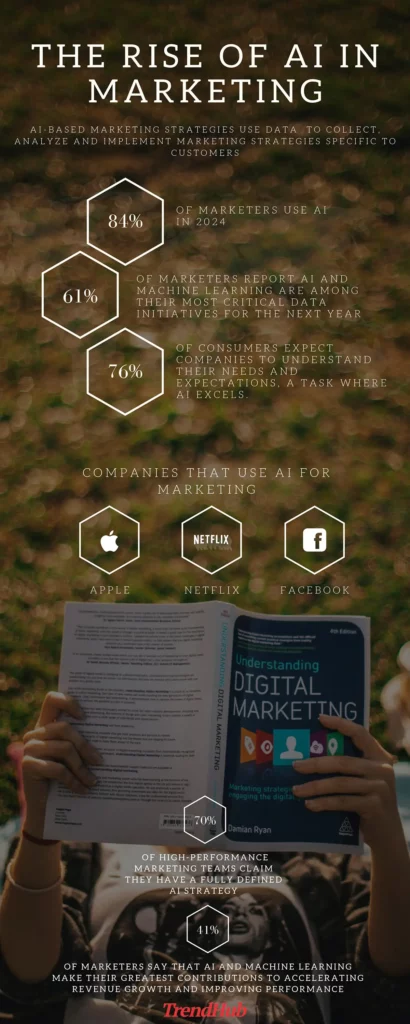
- 84% of marketers use AI in 2024.
- 61% of marketers report AI and machine learning are among their most critical data initiatives for the next year.
- 76% of consumers expect companies to understand their needs and expectations, a task where AI excels.
The Role of AI in Marketing Today
#1 Personalization and Customer Insights
AI enables marketers to analyze vast amounts of data quickly and accurately, leading to highly personalized marketing strategies. Tools like chatbots and recommendation engines use AI to tailor interactions to individual consumer preferences, enhancing the customer experience.
Example: Amazon‘s recommendation system, which uses AI to analyze browsing and purchasing patterns, drives approximately 35% of its total sales.
#2 Content Creation and Curation
AI can assist in content creation, from generating social media posts to drafting email newsletters. Tools like Copy.ai and Jasper (formerly Jarvis) are becoming popular for their ability to produce human-like text based on specific inputs.
#3 Predictive Analytics
Predictive analytics, powered by AI, allows marketers to anticipate future consumer behaviours and trends. This can lead to more effective campaign planning and resource allocation.
Will AI Replace Marketers?
Despite AI’s growing capabilities, the notion that AI will completely replace human marketers is far-fetched. Here are a few reasons why:
#1 Creativity and Emotional Intelligence
Marketing is not just about data; it’s also about storytelling, creativity, and emotional connections. While AI can analyze data and even generate content, it lacks the nuanced understanding of human emotions and creativity that human marketers bring to the table.
#2 Strategic Thinking
AI excels at processing information and identifying patterns, but strategic thinking involves understanding complex market dynamics, cultural nuances, and long-term brand building—areas where human intuition is crucial.
#3 Ethical Considerations
AI operates based on the data it is fed, sometimes leading to biased or unethical outcomes. Human oversight is necessary to ensure that marketing practices are ethical and align with societal values.
The Future: A Collaborative Approach
Rather than viewing AI as a replacement, it’s more realistic to see it as a powerful tool that can augment human capabilities. The future of marketing lies in a collaborative approach where AI handles data-driven tasks, freeing up human marketers to focus on creative and strategic endeavours.
Infographic: AI and Human Collaboration in Marketing
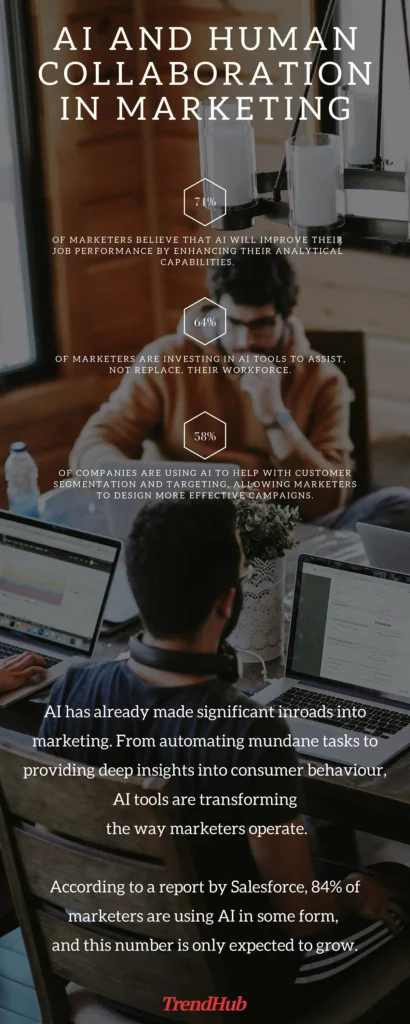
- 71% of marketers believe that AI will improve their job performance by enhancing their analytical capabilities.
- 64% of marketers are investing in AI tools to assist, not replace, their workforce.
- 58% of companies are using AI to help with customer segmentation and targeting, allowing marketers to design more effective campaigns.
AI is undoubtedly transforming the marketing landscape, offering tools and insights that were once unimaginable. However, the heart of marketing—creativity, human connection, and strategic vision—remains firmly in the hands of human professionals. By leveraging AI as a supportive tool, marketers can enhance their efficiency and effectiveness, ensuring that the human touch continues to play a vital role in the art of marketing.
References:
- Salesforce. (2023). State of Marketing Report.
- HubSpot. (2023). The Future of AI in Marketing.
- Gartner. (2024). Predicts 2024: AI and the Future of Work.


